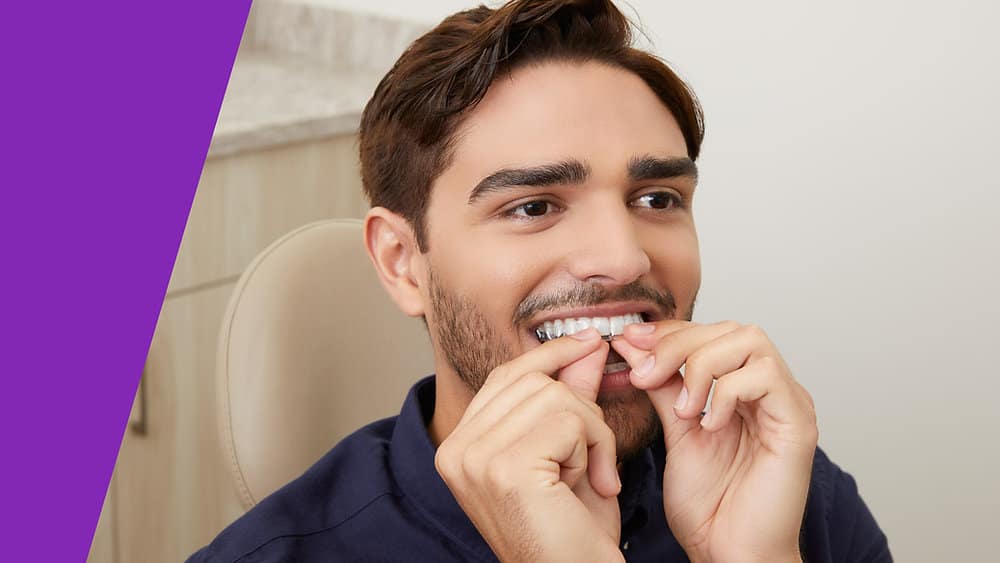
The computer can draw a perfect smile. An experienced orthodontist must decide whether your teeth can safely—and actually—get there.*
On Dr. Suzanne Dennis’s computer screen, crowded teeth can become straight in seconds. A canine turns. A gap closes. The front teeth line up in a smooth arc, and the bite appears to settle neatly into place. It is one of the most compelling parts of modern clear-aligner treatment—and one of the easiest to misunderstand. The animation makes the result look inevitable. It is not.
What appears on the screen is a digital treatment setup. Invisalign calls its version a ClinCheck treatment plan. It is a remarkably useful model of what the aligners will be designed to do, but it is still a proposal. Before Dr. Dennis approves it, she studies the ending, the path used to reach it, and the forces each tray is meant to deliver. A computer can place a digital tooth almost anywhere. A real tooth has a root, a ligament, surrounding bone, gum tissue, neighboring teeth and a bite to fit into.
Dr. Dennis has been making that distinction since Invisalign was introduced. She began practicing orthodontics in Charlottesville in 1998, the same year the system received FDA clearance, and became an early adopter. She knew the first-generation product, watched it grow into a serious orthodontic tool and has now seen the field expand into a crowded market of aligner systems. That history matters because she knows both what modern aligners can do beautifully and where a beautiful animation can get ahead of biology.
The short version, if you are in a hurry
- Invisalign does not simply scan your teeth and let a computer decide what your smile should look like. Dr. Dennis diagnoses the problem, establishes the treatment goals, reviews the proposed final setup and changes the plan before approving it.
- The number of aligners is not chosen at random. The planned movement is divided into a sequence of small stages. The distance, difficulty, order and speed of those movements all affect the number of trays.
- Invisalign is one brand in a much larger clear-aligner category that now includes Clarity Aligners, Angel Aligner, Spark, ClearCorrect, SureSmile and others. The best choice depends on the patient and the treatment plan—not just the name on the package.
- Aligners can work exceptionally well, but only while they are in the mouth. Most patients should plan on 20 to 22 hours of wear each day, with 22 hours as the practical target unless Dr. Dennis gives different instructions.
- The digital plan is powerful. Dr. Dennis’s experience is what makes it personal, realistic and medically sound.
That is the essential answer. If that is all you wanted to know, you can stop here. If you are curious about who chooses the “perfect” smile on the screen, why one patient receives 18 aligners and another receives 48, or why Dr. Dennis may prefer one kind of plastic at one stage and another later, keep reading.
Who decides what the finished teeth should look like?
The short answer is: the orthodontist does—with help from sophisticated software and digital production teams.
Treatment begins with records, not an animation. Dr. Dennis examines the teeth and bite, facial balance, jaw relationships, gum health and any growth that remains. She reviews photographs, a digital scan and the necessary X-rays. A surface scan captures the visible crowns and gums very well; it does not, by itself, show the complete position of the roots or the shape and limits of the supporting bone. That is one reason an orthodontic diagnosis involves more than uploading a scan.
Dr. Dennis then prescribes the goals. Those goals are not merely “make the front teeth straight.” She may be planning where the midlines should meet, how much overbite and overjet are appropriate, where space should be created or closed, how the upper and lower arches should relate, how the roots should be positioned and where the teeth should meet when the patient bites.
With Invisalign, the prescription, scan and the doctor’s saved clinical preferences are used to generate an initial ClinCheck setup. Depending on the workflow, software can create the first proposal and a digital technician may also become involved. Other aligner companies have their own versions of this process.
Then comes the part patients rarely see: Dr. Dennis reviews the plan. She can move individual teeth, alter the arch form, change spacing, revise enamel reduction, add or remove attachments, plan elastics, change the treatment approach and request different staging. Invisalign’s current planning tools explicitly allow the doctor to review, modify and approve the plan. Manufacturing does not begin until the doctor approves it.
A useful way to think about it: The software is an extraordinarily capable drafting table. It can calculate and redraw at tremendous speed. Dr. Dennis is still the architect—and the teeth still have to obey biology, not graphics.
Why a flawless digital ending can still be the wrong ending
After years of treating patients with aligners, certain problems can jump out at Dr. Dennis quickly. She does not stop at the last frame and ask, “Does this look straight?” She asks whether the setup is mechanically achievable, whether it respects the patient’s anatomy and whether the bite will actually function when the front-facing image looks finished.
A proposed setup may need revision because:
- the crowns look aligned while the roots are not ideally positioned;
- expansion is being represented as bodily movement when the teeth may simply tip outward;
- a round canine or premolar is being asked to rotate more predictably than plastic can grip it;
- one tooth is expected to move through a space another tooth has not yet created;
- the plan depends on anchorage that has not been adequately protected;
- the front teeth look attractive, but the back teeth do not meet properly;
- the scan does not contain all the biological information available in the patient’s X-rays and examination; or
- the proposed pace or sequence is more optimistic than Dr. Dennis believes that patient’s teeth and tissues will tolerate.
This does not mean the software has “failed.” It means the software and the orthodontist have different jobs. A digital system is excellent at applying programmed rules, displaying alternatives and manufacturing hundreds of individually shaped appliances. Dr. Dennis must connect that model to a particular patient—then recognize when the model needs to change.
That judgment was earned one patient at a time. Because Dr. Dennis used aligners when they were far more limited than they are today, she has seen which apparent improvements became dependable clinical advances and which movements still deserve caution, extra attachments, elastics, slower staging, a refinement—or a different appliance altogether.
How does the computer decide the number of aligners?
It is less mysterious than it sounds. Imagine asking a tooth to travel from Point A to Point B. One aligner is not made to perform that entire movement at once. The software divides the trip into small stages, and each aligner represents the next planned position.
But total distance is only part of the calculation. The number of aligners also depends on:
- which teeth are moving and how they are moving;
- how much movement is programmed into each stage;
- whether movements occur together or in sequence;
- where space and anchorage must come from;
- whether the plan includes bite correction, elastics or overcorrection; and
- whether Dr. Dennis changes the staging to make a difficult movement more realistic.
When the plan changes, the number of stages can change with it. A longer series is not automatically a worse plan, and a shorter series is not necessarily more efficient. Sometimes adding stages is the more controlled choice. The useful question is not, “How few trays can the computer make?” It is, “What sequence gives these teeth the best opportunity to track safely and predictably?”
Even a carefully designed first series may be followed by a new scan and refinement aligners. That is not necessarily a sign that treatment went wrong. It is how an orthodontist incorporates what the teeth actually did instead of pretending the original simulation was a guarantee.
Invisalign changed the process—not the biology
The idea of moving teeth with removable appliances is much older than Invisalign. In 1945, orthodontist Harold Kesling described a rubber tooth positioner and observed that a series of appliances could, in principle, move teeth progressively. Later clinicians developed clear vacuum-formed appliances and retainers that could make small corrections.
The obstacle was practical. To make a long sequence, technicians would have needed to cut and reset teeth on plaster models over and over again. It was an elegant idea trapped inside a laborious process.
In the late 1990s, Align Technology connected that old orthodontic insight to 3D computing and mass customization. Digital teeth could be staged on a screen, and a complete series of individualized aligners could be manufactured at scale. Invisalign received FDA clearance in 1998 and entered commercial use soon afterward.
That is where the history becomes personal for this practice. Dr. Dennis was already beginning her career in Charlottesville as Invisalign entered orthodontics. She adopted the technology early, when its core processes were new, its early patents still helped make it unique and the appropriate case range was much narrower. She did not learn aligners as a finished product. She learned alongside their evolution.
Over time, better scans, improved plastics, small tooth-colored attachments, elastics, bite features, more sophisticated software and digital monitoring expanded what aligners could accomplish. Dr. Dennis saw those changes not as a timeline of product launches, but as changes in real treatment: a tooth that became easier to control, a bite correction that became more practical, or a lagging movement that could be detected sooner.
Fun fact: The clear tray may look simple, but modern aligner treatment is a combination of orthodontic diagnosis, biomechanics, software, materials science and highly customized manufacturing. The least complicated-looking appliance may have the most elaborate planning behind it.
Invisalign is now a brand inside a category
Invisalign became so familiar that its name is sometimes used to mean any clear-aligner treatment, much as a famous brand can become shorthand for an entire product category. Today, orthodontists can choose among Invisalign, Clarity Aligners, Angel Aligner, Spark, ClearCorrect, SureSmile and other doctor-directed systems. Some practices and laboratories also have in-house or partner manufacturing options.
These are not identical trays with different logos. Systems can differ in planning software, material properties, thickness, trim line, attachment design, available bite features, manufacturing, clinical support and the amount of control they give the treating doctor.
Dr. Dennis’s long Invisalign experience gives her a valuable reference point for evaluating those choices. She can ask whether a new feature solves a real clinical problem she has seen—not simply whether it sounds new. In some patients, a particular system or material may provide a useful advantage. In others, the bigger decision is whether removable aligners are the right tool at all.
Patients therefore do not need to arrive at a consultation having chosen a brand. “Which system is best?” is usually less useful than “Which treatment design makes the most sense for my teeth, my bite and my life?”
Why Dr. Dennis likes having more than one kind of plastic
Clarity Aligners—developed by 3M and now part of Solventum’s orthodontic portfolio—offer an interesting example of how the category has matured. The system provides Flex and Force options with different thicknesses and mechanical force profiles. A case can be designed with Flex, Force or both.
The names describe the basic idea. Flex is the thinner, more flexible option. Force is thicker and designed to express a different level of mechanical force. That gives Dr. Dennis another planning lever: she can choose a material profile for the patient or stage of treatment instead of assuming that one plastic must do every job from the first tray to the last.
It is not a claim that Clarity is universally better, or that two choices automatically produce a better result. Materials cannot rescue a poor diagnosis, an unrealistic setup or trays that are not worn. But in the hands of an orthodontist who understands what she wants an aligner to do, the ability to choose between Flex and Force—or combine them in one treatment design—can be genuinely useful.
That is the quiet advantage of competition in the aligner market. It has given experienced orthodontists more tools. Dr. Dennis can select from them without confusing the tool with the treatment.
The 22-hour truth
There is one piece of aligner technology no manufacturer has managed to eliminate: the patient has to wear it.
For most patients, Dr. Dennis wants the aligners in place about 22 hours a day, removed for meals, drinks other than water, brushing and flossing. The exact instruction may vary, but aligners generally need 20 to 22 hours of daily wear. An aligner on the nightstand exerts exactly zero force.
Each tray assumes the teeth have reached the position programmed into the tray before it. If it is worn for only part of the day, a tooth may fall behind. The next tray is still manufactured for the next destination, so it may not seat fully. A small discrepancy can then follow the patient from tray to tray until the aligner no longer “tracks” the teeth closely.
This is not about scolding patients. It is about choosing honestly. Some people love being able to remove their appliance and quickly build aligners into their routine. Others know that lunch will turn into an afternoon without trays, or that a teenager’s aligners may spend more time in a backpack than in the mouth. In those cases, braces may be the more liberating option because they keep working without a daily wear-time decision.
If an aligner stops fitting, the answer is not to hide it and hope. Dr. Dennis can determine whether to wear a tray longer, return to an earlier tray, adjust the appliance, obtain a new scan or revise the plan. Her practice also uses digital monitoring when appropriate to help identify fit and tracking changes between selected office visits. Read more in Benefits of Dental Monitoring and Virtual Orthodontic Care.
Where aligners shine—and where experience may choose something else
Modern aligners can be an excellent choice for many patients with crowding, spacing and selected bite problems. They are discreet, removable for eating and allow normal brushing and flossing. With thoughtful planning and auxiliaries, they can handle cases that early Invisalign users would never have attempted.
But some rotations, extrusions, root movements, extraction-space closure, major jaw discrepancies and anchorage demands remain less predictable or more efficient with another approach. Some patients benefit from attachments or elastics. Some need a hybrid plan. Some will get a better, simpler result with braces.
Dr. Dennis is not committed to making every patient fit an aligner. She has modern custom braces available, too, including LightForce. That freedom matters: a recommendation means more when the orthodontist is equally comfortable explaining why aligners fit the case—or why another tool offers better control. For a closer comparison, read LightForce Braces vs. Traditional Braces.
The same is true of bite problems. Two patients may both say they have an “overbite,” yet the causes can be quite different and may call for different mechanics. Learn more in Effective Orthodontic Solutions for Treating Overbites.
The part of aligner treatment you cannot see
Clear aligners have come a long way since Dr. Dennis first began using Invisalign. The scans are faster. The software is more powerful. The materials and attachments offer more control. The list of brands is longer. And the final animation has never looked better.
What patients cannot see is the judgment behind the animation: the decision to alter a root position, slow a rotation, change the order, add an attachment, protect the bite, switch materials, rescan—or decline to use aligners at all.
That is where Dr. Dennis’s experience lives. She has treated many patients across the entire modern life of clear-aligner therapy, from Invisalign’s early days to today’s broad menu of systems. She can appreciate the computer without being dazzled by it.
If you are considering Invisalign, Clarity Aligners, another clear-aligner system or braces, schedule a FREE consultation with Dr. Suzanne Dennis or call 434-973-4446.
You do not need to choose an appliance before you arrive. Bring your questions—and, if you have seen a perfect digital smile somewhere else, bring those too. Dr. Dennis will help you understand not only how the finish looks on a screen, but how your teeth can realistically and healthfully get there.