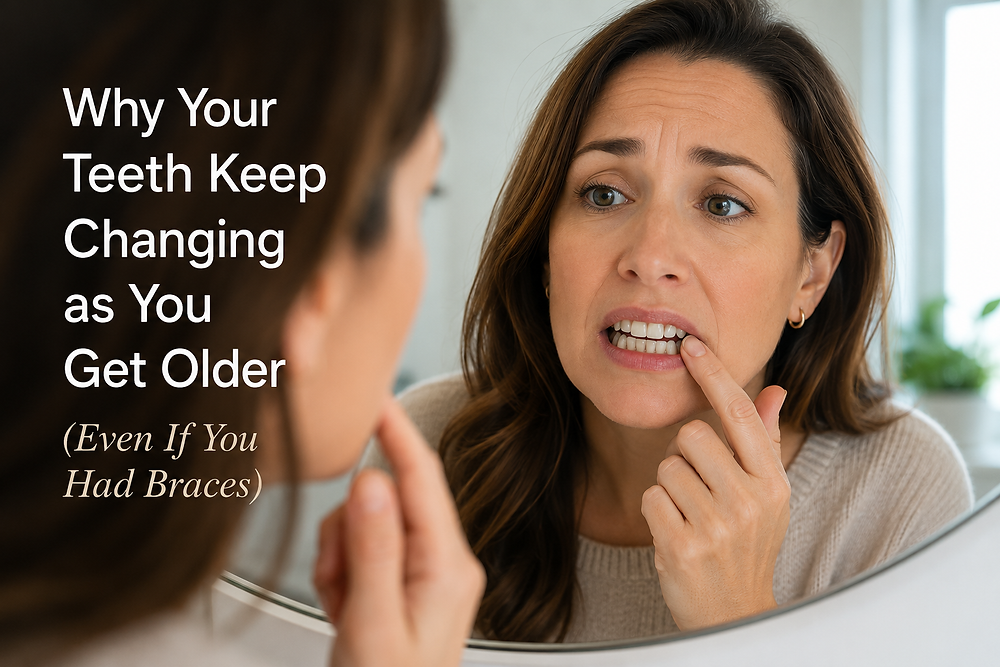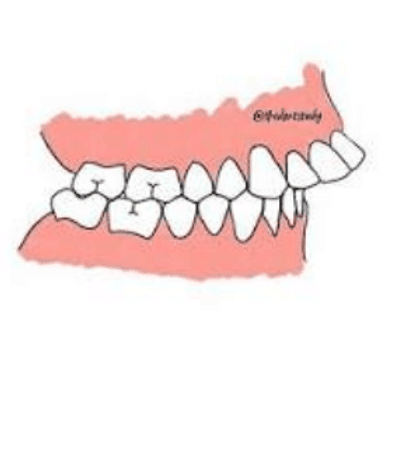
Parents sometimes notice that a child’s upper teeth seem to sit much farther forward than the lower teeth. Adults may describe the same problem as “buck teeth,” an overbite, or simply a weak chin. Orthodontists use more specific language: this type of bite relationship is often called a Class II malocclusion.
A normal bite should have some horizontal overlap, with the upper front teeth resting slightly ahead of the lower front teeth. In a Class II bite, that relationship is excessive. The upper teeth, upper jaw, or both are positioned too far forward relative to the lower teeth and jaw.
What matters most is not simply recognizing that a Class II bite exists. The important question is why it exists.
Class II Malocclusions Do Not All Have the Same Cause
A Class II bite can result from several different conditions:
- Sometimes the upper teeth are simply angled too far forward.
- In other patients, the upper jaw itself is prominent.
- Frequently, the main issue is a lower jaw that is smaller or positioned farther back than expected.
- Some patients have a combination of these dental and skeletal factors.
This distinction is important because orthodontic treatment should address the origin of the problem rather than treating every Class II bite in exactly the same way. The American Academy of Pediatric Dentistry recognizes that Class II malocclusions may be dental, skeletal, or a combination of the two. Treatment planning should consider the patient’s growth pattern, age, severity of the discrepancy, available space, and ability to cooperate with treatment.
- A relatively mild dental Class II problem may be corrected by moving the teeth into better positions.
- A significant skeletal discrepancy caused by a small lower jaw may require a very different approach.
When the Lower Jaw Is Too Small
A smaller or retrusive lower jaw can affect more than the way the teeth fit together.
- In moderate cases, the lower jaw may simply make the upper teeth appear more prominent.
- In more severe cases, it can affect chewing, lip closure, facial balance, and the appearance of the chin and jawline. The profile may look more convex because the chin sits noticeably behind the upper portion of the face.
A small lower jaw can also contribute to limited airway space in certain patients. This does not mean that every person with a Class II bite has an airway problem or sleep apnea. Airway concerns are complex and may involve the tonsils, adenoids, nasal passages, tongue position, body anatomy, and other medical factors.
When a severe skeletal Class II discrepancy is treated surgically, advancing the lower jaw can increase chin prominence and enlarge parts of the upper airway. Research has found increases in airway dimensions following mandibular advancement surgery. However, airway symptoms still require appropriate medical evaluation and cannot be diagnosed from the bite alone.
Prominent Upper Front Teeth Are Not Just a Cosmetic Concern
Some Class II bites are characterized by upper incisors that flare dramatically forward. In certain children, the lower lip becomes trapped behind these teeth. Each time the child closes their lips or swallows, the lower lip may press against the backs of the upper incisors, encouraging them to flare even farther forward.
This pattern can:
- Make comfortable lip closure difficult.
- Interfere with speech, biting, and other oral functions.
- Cause a child to feel self-conscious about smiling or showing their teeth.
More importantly, severely protruding incisors are more vulnerable to injury. When the upper front teeth extend beyond the normal facial and lip profile, they have less protection during a fall, collision, or sports accident. Instead of the lips and surrounding facial structures absorbing the initial impact, the incisors may become one of the first points of contact.
A systematic review published in the European Journal of Orthodontics found that children with an overjet greater than three millimeters had approximately twice the risk of injury to their front teeth compared with children whose overjet was less than three millimeters. The American Academy of Pediatric Dentistry also reports that very large overjets—greater than eight millimeters—are associated with dental trauma in more than 40 percent of children.
Does Every Class II Bite Need Early Treatment?
No. Some severe Class II malocclusions can benefit from treatment while a child is still growing, but many are treated just as effectively with a single phase of comprehensive orthodontic treatment during adolescence.
Early treatment is most useful when there is a specific reason not to wait. A marked overjet with highly exposed upper incisors is one of those reasons. Other considerations may include:
- Worsening lip entrapment.
- Significant functional problems.
- Severe psychosocial concerns.
- A jaw relationship that may benefit from an orthopedic appliance during growth.
For carefully selected children, early treatment may reduce the overjet, improve the relationship between the upper and lower jaws, reduce the severity of the developing malocclusion, and provide greater protection for the upper incisors.
Evidence reviewed by Cochrane found that early treatment for prominent upper front teeth can reduce the incidence of incisor trauma. However, the review did not find a consistent long-term advantage to treating every Class II patient in two phases rather than waiting and completing one course of treatment during adolescence.
How Is a Class II Malocclusion Corrected?
There is no single appliance or technique that is right for every Class II patient. Depending on the nature, origin, and severity of the problem, treatment may involve:
- Braces alone: When the discrepancy is primarily dental and adequate space is available, braces and elastics may be used to improve the relationship between the upper and lower teeth.
- Braces combined with an orthopedic or functional appliance: In a growing patient, an appliance may be used to encourage a better relationship between the upper and lower jaws. Braces are then used to refine the tooth positions and create a stable bite.
- Braces combined with extractions: When the upper teeth are significantly protrusive or there is severe crowding, removing selected permanent teeth may provide the space needed to retract the incisors and improve lip position. Extraction treatment moves the teeth within the existing jaws; it does not make a small lower jaw larger.
- Braces combined with orthognathic surgery: Most Class II malocclusions can be treated without jaw surgery. In a severe skeletal discrepancy, however, orthodontics alone may not fully correct the facial imbalance or functional problem. Once facial growth is complete, braces may be combined with orthognathic surgery to advance the lower jaw, improve the bite, increase chin prominence, and potentially increase airway space.
The Goal Is More Than Straight Teeth
Successful Class II correction should:
- Create an appropriate amount of overjet and overbite.
- Improve the way the back teeth fit together.
- Support normal oral function.
- Produce a smile and facial profile that are balanced with the patient’s natural anatomy.
If you are in Charlottesville and are concerned about prominent upper teeth, a small lower jaw, a lower lip that becomes trapped behind the front teeth, or whether your child could benefit from early treatment, Dr. Suzanne Dennis would be happy to help you understand the cause of the problem and the available treatment options. Dr. Dennis has been treating children, teenagers, and adults in Charlottesville since 1998 and has extensive experience determining which Class II malocclusions should be treated early—and which are better treated later in a single comprehensive phase.